
Utilitarian Way
Money as a utility
A Utilitarian Way of Thinking About Money and Life
The Utilitarian way of thinking questions “how can I use my resources to create the maximum amount of “utility” (well-being or happiness) for the greatest number of people?”
In this framework, money is not a goal or a status symbol; it is a tool for impact.
I recently came accross an interview with Jason Oppenheim. He says “I like to think about money in a utilitarian way—not as something to accumulate endlessly, but as a tool. A tool whose highest purpose is utility. And the best utility money can have is this: reducing stress and increasing happiness, for yourself and for others”. Its a wonderful way to think about money.
Money, when used well, should make life lighter.
Money as a Stress-Reduction Tool
The best use of money, in my view, is to de-stress your life. Not to impress, not to compete, not to prove anything—but to remove friction.
As per Jason Oppenheim, at this point in his life, he don’t “do everything” anymore. And that’s intentional.
He says that he has:
- A driver
- A stylist
- A personal assistant
- A grocery shopper
- A dog walker
- A therapist
- Real Estate business with 4 offices staffing many
Jason Oppenheim says that “each of these expenses directly improves the quality of my life. They save time, reduce mental load, and free up emotional energy. That energy can then be spent on things that actually matter—thinking clearly, being present, enjoying life”.
That, to me, is money doing its job.
The Worst-Case Scenario Test
Jason Oppenheim suggest this test. “I often run a simple mental exercise: What’s the worst thing that can happen here?
“Let’s say a contractor overcharges me—$1,400 for a job that should’ve cost $900. I don’t lose sleep over it. I ask myself:
- Is this the end of the world? No.
- Does this materially change my life? No.
- What might that extra $500 mean to him?
Maybe he takes his family out for dinner. Maybe it covers groceries. Maybe it removes stress from his own life for a week or a month.
Now compare that to me. I’m worth many millions. What does $500 really change for me? Almost nothing.
So who would use that money better—me or him? Definitely him.”
From a utilitarian perspective, the net happiness in the world increased. He says “if the absolute worst thing that happens when I die is that I realize I made a lot of people a little happier along the way, that feels like a life well lived”. That is a wonderful thought to have at your death bed.
The Utilitarian View of Happiness
Utilitarian thinking asks a simple question: Who experiences more happiness as a result of this decision?
That question changes everything.
Jason Oppenheim says “It’s why I like giving large tips—to the bathroom attendant, the valet, the server. Not because I’m careless with money, but because I understand its psychological impact.
That extra tip barely registers in my emotional life. But for them? It can genuinely brighten their day. That imbalance is exactly why it makes sense.”
It’s Not About Money—It’s About Psychology
This mindset isn’t really about money at all. It’s about psychology.
When you stop obsessing over small losses, your anxiety drops. Your stress drops. Cortisol levels come down. You become more light-hearted, more easygoing.
You stop taking things personally. Other people’s actions are reflections of them, not you. There’s no need to internalize every inconvenience or mistake.
You also stop sweating the small stuff. Most things—probably 99%—resolve themselves if you just let them. Fighting every minor issue only drains energy that could be used elsewhere.
The Nature of a Utilitarian Mindset
A utilitarian way of thinking naturally leads to:
- Being less serious about trivial things
- Being more relaxed and light-hearted
- Sleeping better at night
- Letting go of unnecessary resentment
- Valuing peace over precision
It’s a mindset that prioritizes overall well-being-yours and others’-over being “right,” saving every dollar, or winning every interaction.
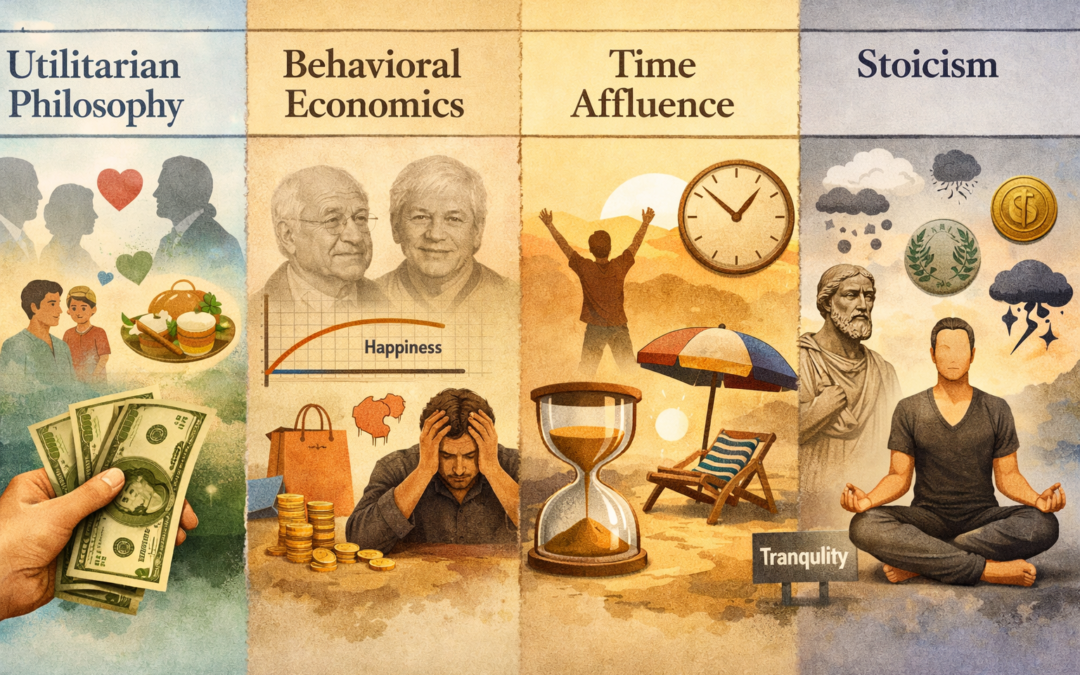
What Philosophy, Psychology, and Economics Say
Several schools of thought support this concept from different angles:
1. Utilitarian Philosophy (Jeremy Bentham, John Stuart Mill)
Classical utilitarianism argues that the moral value of an action lies in its ability to
maximize overall happiness.
Applied to money:
- A dollar means more to someone who lacks it than to someone who has excess
- Redirecting resources where they create the most well-being is rational, not sentimental
- Generosity and overpaying in small contexts can be ethically optimal
The “who benefits more from this $500?” question is pure utilitarian reasoning.
2. Behavioral Economics (Daniel Kahneman, Richard Thaler)
Research consistently shows:
- Happiness plateaus quickly with material purchases
- Stress reduction has a far larger impact on life satisfaction
- Small financial losses hurt emotionally only when we obsess over them
Kahneman’s work on experienced well-being supports the idea that peace of mind today
matters more than theoretical optimization.
3. Psychology of Time Affluence
Modern psychology introduces the concept of time affluence — the feeling of having enough time.
Studies show:
- People who spend money to save time report higher happiness
- Hiring help reduces cognitive overload
- Reduced cortisol and decision fatigue improve long-term mental health
This directly supports outsourcing tasks like driving, shopping, and scheduling.
4. Stoicism (Ancient but Relevant)
Stoics like Seneca argued that:
- Losses only harm us if we emotionally cling to them
- External events (like being overcharged) don’t disturb us — our judgments do
- Wealth is best used to create tranquility, not control
The “is this the end of the world?” framing mirrors Stoic reasoning almost exactly.
Final Thought
Money is powerful, but not because of what it can buy. It’s powerful because of what it can remove: stress, worry, friction, and unnecessary suffering.
If using money a little more freely means more happiness in the world-and less anxiety in your own mind—that’s not wasteful.
That’s utilitarian.
Wealth isn’t about maximizing assets.
It’s about minimizing unnecessary suffering—yours and others.
That’s why this philosophy feels less like financial advice and more like psychological maturity. It’s not about money at all-it’s about how calmly and generously one can move through the world.
Software Engineer & Data Science| SQL, Analytics, and AI Solutions
Nuwan Hettiarachchi
I bring strong experience in data analytics and data engineering, with a focus on SQL-driven data preparation, data quality, and scalable processing pipelines. My background includes working with large, complex datasets, supporting business intelligence, and applying data governance principles such as profiling, lineage, and documentation. I am known for collaborating effectively across teams to design clear, reliable data solutions that support informed decision-making.

My Story
From Curiosity to Craft: My Journey in Technology and Analytics
My name is Nuwan Hettiarachchi, and my journey has been guided by curiosity, service, and a strong belief in using technology to create meaningful impact.
I began my professional path working closely with data, systems, and people. Early on, I realized that I enjoyed solving practical problems—especially those where analytical thinking and real-world needs intersect. This led me into data analytics, automation, and software development, where I’ve spent years building tools that improve accuracy, efficiency, and decision-making.
A defining part of my journey has been 10 years of volunteer teaching at a charitable organization. Teaching reinforced my belief that knowledge is most powerful when shared. It strengthened my communication skills, patience, and ability to break down complex ideas—skills that continue to shape how I design systems and collaborate with teams today.
Professionally, I’ve worked across data analysis, reporting, and application development. One notable experience was developing a Human Resources appraisal system over two years using Visual Basic and SQL Server, where I translated business rules into reliable, user-friendly software. Projects like this deepened my appreciation for clean data, thoughtful design, and systems that support people—not just processes.
Over time, my work expanded into Python, SQL databases, analytics, and automation, with a growing focus on data integrity and insight-driven solutions. I enjoy building tools that reduce manual effort, surface meaningful patterns, and enable better decisions.
Outside of work, I value balance and mindfulness. I enjoy hiking, traveling, kayaking, and spending time in nature—activities that keep me grounded and curious.
Today, I’m focused on contributing within data science and analytics–driven environments, continuing to learn, mentor, and build solutions that are practical, ethical, and impactful.
Technologies I’ve Worked With


Phone
(604) 256-2432
Surrey BC, Canada