When Numbers Lie
How Inaccurate Visualizations Create False Narratives
Quick Note
This is a sample analysis I have done to discover a problem in a potential customer facing report that is rich with visualizations. I have discovered the problem, analyzed for a possible solution and then made suggestions for improvements.
Problem
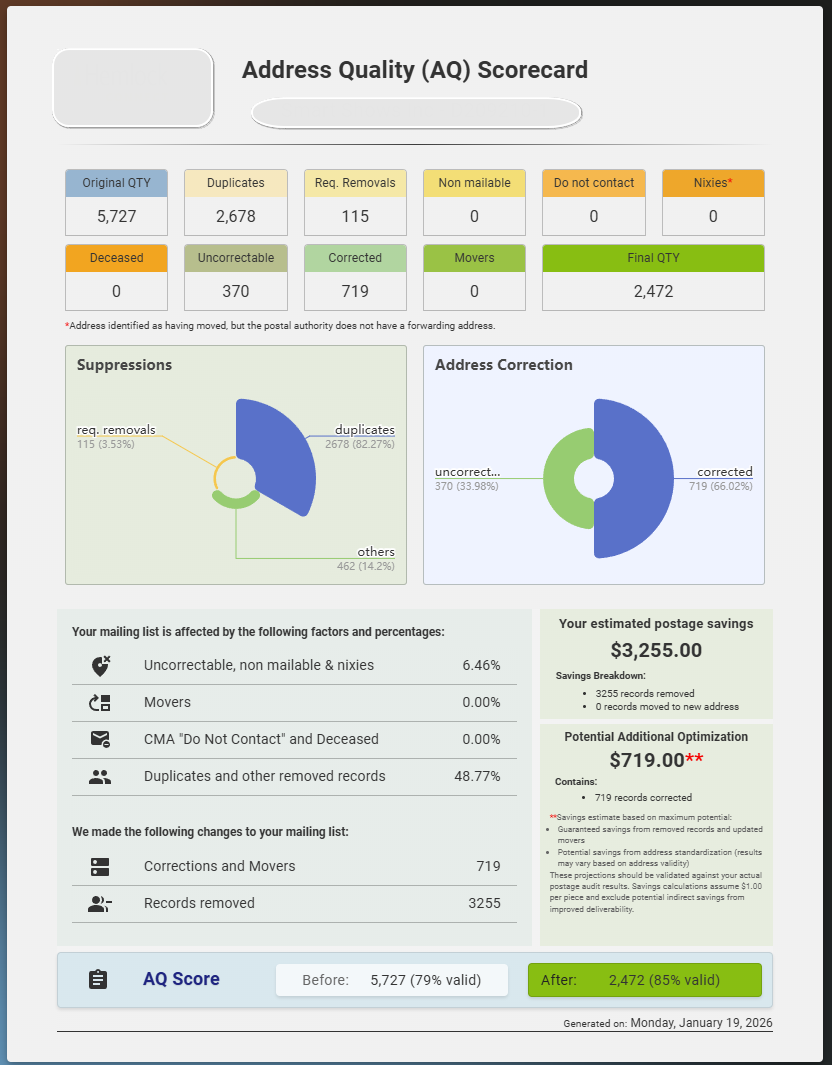
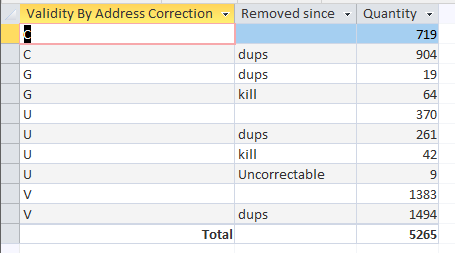
Words we use to describe our numbers carry a huge weight. In this visualization, we are telling there is an additional 719$ optimization potential. When questioned how that is possible, the answer from the creator of this visualization is “by applying data correction”. However, the table shows this 719 is already corrected. That means all possible optimizations have already been added. Hence, saying “Potential additional optimization” is misinformation.
We can rather say, that “719$ saving” from choosing to do address correction and optimization. Since customer has already paid for this, there is no additional saving here. Its already paid off.
Analysis
That being said, from the customers point of view, there is no much action you can take by looking at this visualization in respect to further optimization.
On the other hand, there is a 48.77% of duplicates being removed. That is money saved there. Rather than putting a dollar value to savings and saying 3255$ savings, it would be consistant in the “number” point of view to present this as a number. This number is meaning less since it directly depends on the mailing size. In that case showing the percentage of savings as a larger number and showing the saving along side with that as a smaller number would present better.
In this case:
the complete mailing would have cost $5727,
with various optimizations saved amount is $3255,
now the mailing costs $2472,
that means optimizations have saved 56.84%.
That is more than half of the budget being saved,
showing a dollar value doesn’t give same impact?
Through strategic optimizations, we reduced our mailing costs by 56.84%. We successfully avoided $3,255 in expenses, bringing the final total down to **$2,472** from an initial estimate of $5,727.
Our optimization efforts resulted in a $3,255 cost avoidance. By refining our mailing process, we were able to complete the project for just $2,472, representing a significant 56.84% savings against the original projected cost.
Better Visualizations
Being said that, what are the better ways to show this optimization? I have collected some suggestions below. Its all dependent on “magnitude of the saving”:
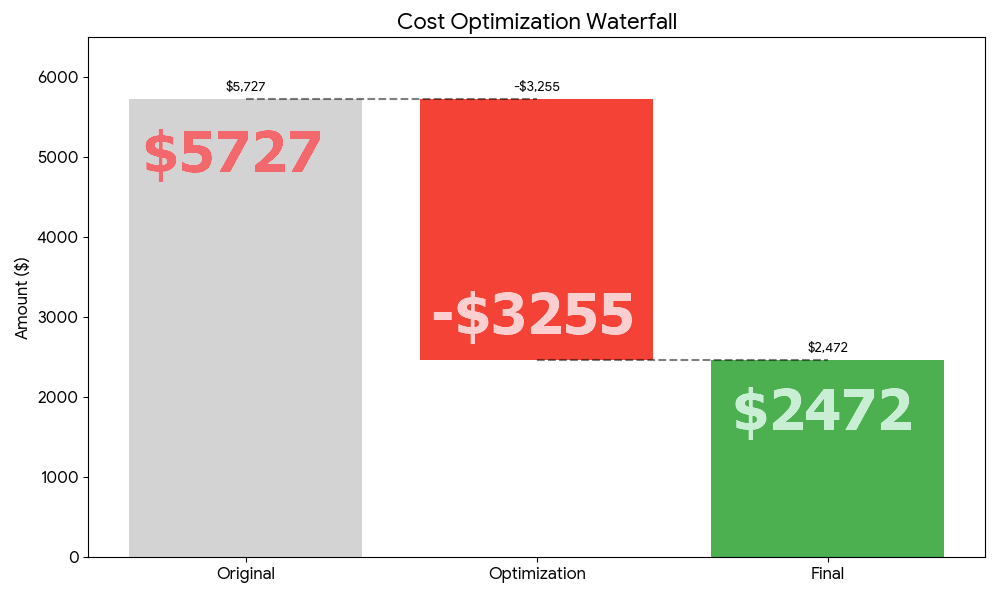
1. The Waterfall Chart (Best for Professional Reports)
This is the “gold standard” for financial optimization. It shows the starting point (Original Cost), the specific action taken (Optimization/Savings), and where you landed (Final Cost). It visually “drops” the price, making the $3,255 savings feel substantial.
2. The “Before vs. After” Comparison (Best for Quick Impact)
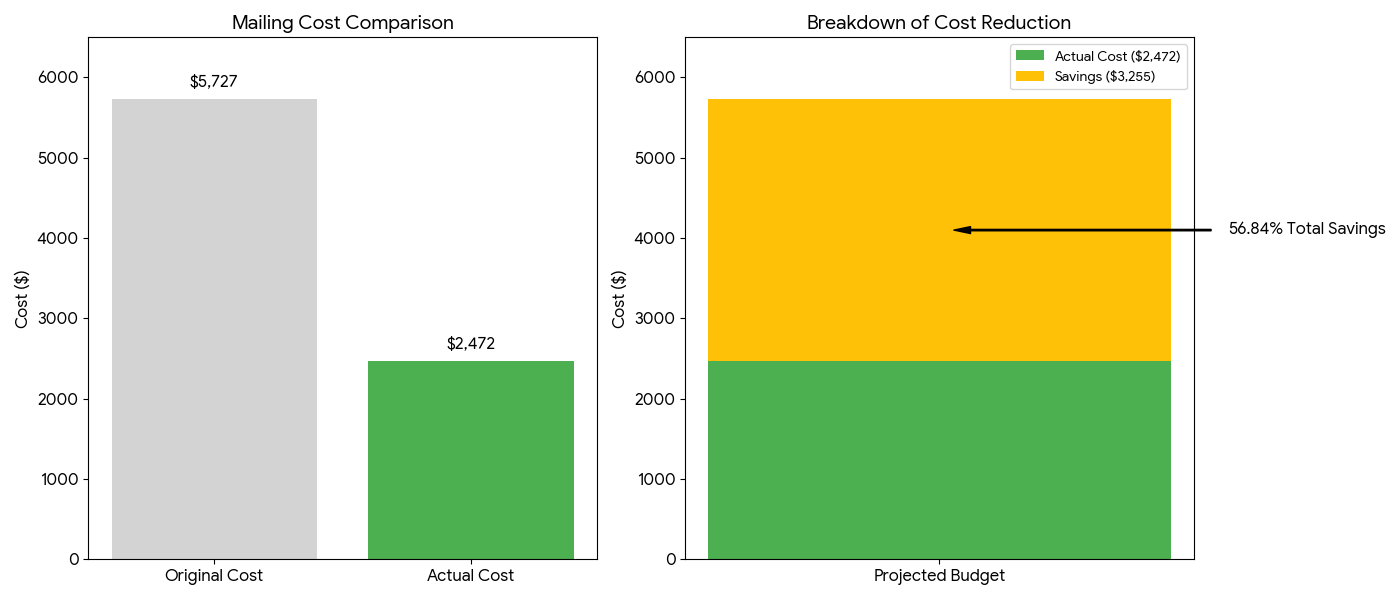
A simple side-by-side bar chart is the most readable. By placing a tall gray bar (Original) next to a shorter green bar (Final), the viewer immediately perceives the efficiency gain without needing to read the numbers closely.
3. The Stacked Component Bar (Best for Efficiency Metrics)
This shows a single bar representing the total original budget ($5,727), divided into “Actual Spend” and “Savings.” This is highly effective because it visually proves that the savings are actually larger than the amount spent.
Suggestions and next steps
Based on this analysis, an important observation is to consider the “magnitude” as a scale to decide on charts and visualizations.
- In case the savings is in range of 30% or more, then use a waterfall chart.
- Otherwise use a stacked component bar (#3 above)
Software Engineer & Data Science| SQL, Analytics, and AI Solutions
Nuwan Hettiarachchi
I bring strong experience in data analytics and data engineering, with a focus on SQL-driven data preparation, data quality, and scalable processing pipelines. My background includes working with large, complex datasets, supporting business intelligence, and applying data governance principles such as profiling, lineage, and documentation. I am known for collaborating effectively across teams to design clear, reliable data solutions that support informed decision-making.

My Story
From Curiosity to Craft: My Journey in Technology and Analytics
My name is Nuwan Hettiarachchi, and my journey has been guided by curiosity, service, and a strong belief in using technology to create meaningful impact.
I began my professional path working closely with data, systems, and people. Early on, I realized that I enjoyed solving practical problems—especially those where analytical thinking and real-world needs intersect. This led me into data analytics, automation, and software development, where I’ve spent years building tools that improve accuracy, efficiency, and decision-making.
A defining part of my journey has been 10 years of volunteer teaching at a charitable organization. Teaching reinforced my belief that knowledge is most powerful when shared. It strengthened my communication skills, patience, and ability to break down complex ideas—skills that continue to shape how I design systems and collaborate with teams today.
Professionally, I’ve worked across data analysis, reporting, and application development. One notable experience was developing a Human Resources appraisal system over two years using Visual Basic and SQL Server, where I translated business rules into reliable, user-friendly software. Projects like this deepened my appreciation for clean data, thoughtful design, and systems that support people—not just processes.
Over time, my work expanded into Python, SQL databases, analytics, and automation, with a growing focus on data integrity and insight-driven solutions. I enjoy building tools that reduce manual effort, surface meaningful patterns, and enable better decisions.
Outside of work, I value balance and mindfulness. I enjoy hiking, traveling, kayaking, and spending time in nature—activities that keep me grounded and curious.
Today, I’m focused on contributing within data science and analytics–driven environments, continuing to learn, mentor, and build solutions that are practical, ethical, and impactful.
Technologies I’ve Worked With


Phone
(604) 256-2432
Surrey BC, Canada