
Late life asset erosion
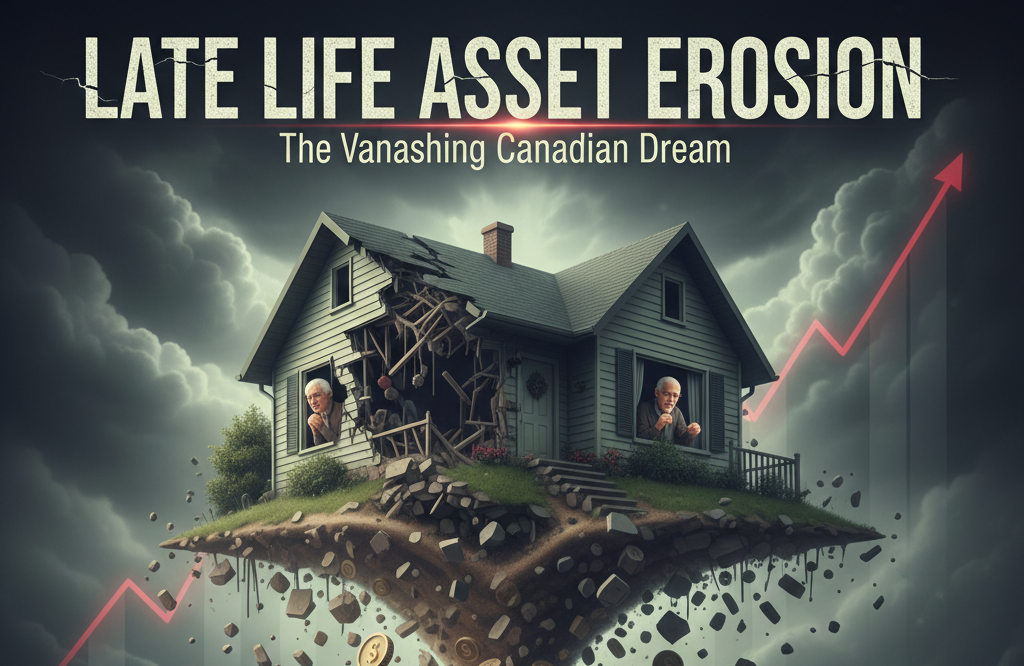
Late life asset erosion is emerging as one of the most serious financial risks facing Canadian seniors, as rising care and housing costs collide with fixed incomes and longer lifespans. For many middle‑class families, the “retirement plan” built around a paid‑off home and modest savings is no longer enough to withstand a decade or more of elevated expenses in very old age.
In a recent video by Regona Sisters, discussed a scenario like below, which I wanted to discuss and discover further.
Scenario
It started with a late night phone call that every person over the age of 40 dreads. On one end, a paramedic. On the other, a son whose entire financial reality was about to be rewritten. His father, David, had suffered a massive stroke. In the medical world, David was a survivor. But in the financial world, he was about to become a casualty of a system designed to drain middle class wealth. The Millers, let’s call them that, thought they were bulletproof. They were the poster family for the Canadian dream. They owned their detached home in the suburbs outright with no mortgage. They had a healthy RRSP. They had followed the script we were all given, and that is to work hard, pay off your debt, and save for a rainy day. But in the space of 24 hours, that retirement plan was exposed for what it really was. It was a fantasy. David’s stroke left him needing constant skilled care. He couldn’t walk and he couldn’t be left alone. The family was suddenly thrown into a financial nightmare of impossible choices, discovering that their life savings were no match for the brutal inflation of the 2026 elder care market.
source : Regona Sisters video ([https://www.youtube.com/watch?v=CVk5ZPCS3OQ](https://www.youtube.com/watch?v=CVk5ZPCS3OQ))
Below is my research on this topic and what I have found out based on this, an eminant future anyone planning a future in Canada.
What is late life asset erosion?
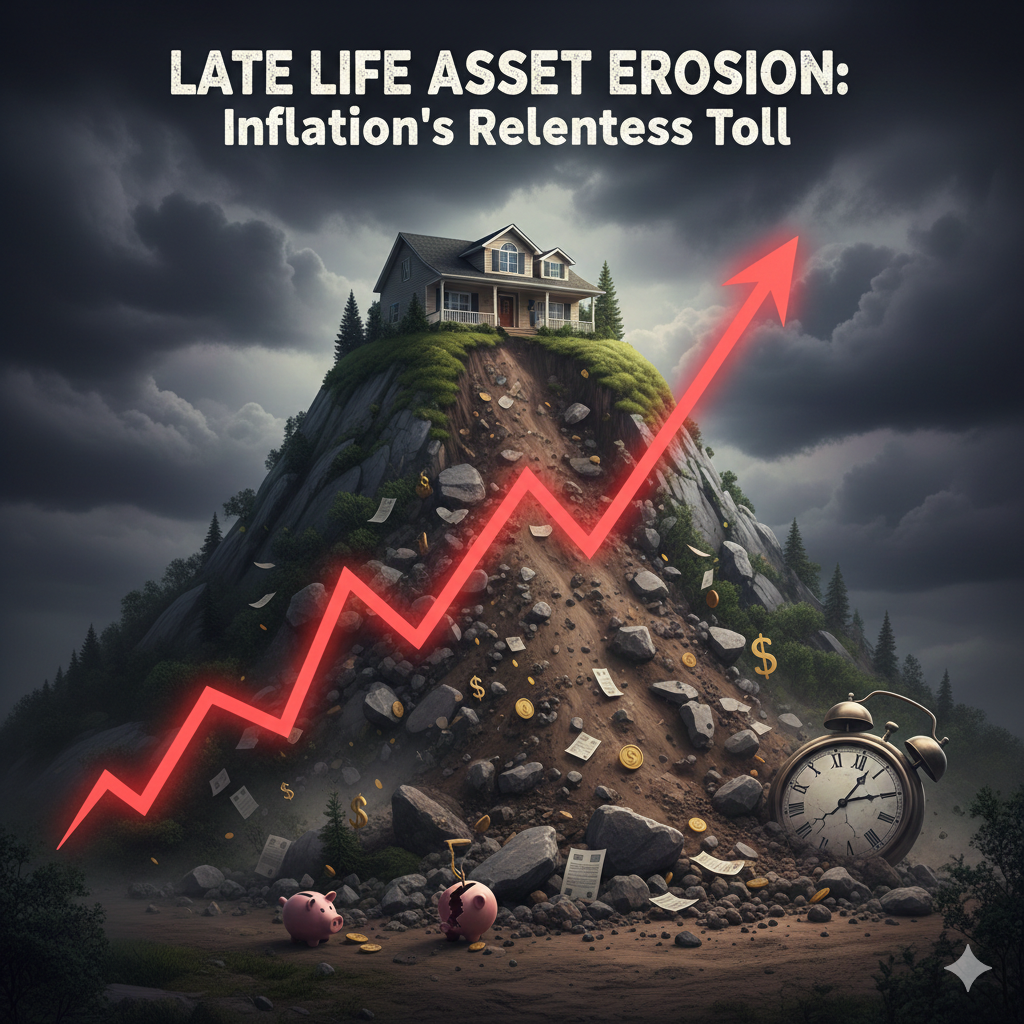
Late life asset erosion is the rapid depletion of savings, home equity, and investments during the final years of life, usually triggered by health decline, loss of independence, or widowhood. In Canada, this often shows up when a senior shifts from relatively low‑cost, independent living to needing paid support at home, assisted living, or long‑term care. The problem isn’t just higher bills; it’s that those bills arrive precisely when it’s hardest to increase income or make major financial changes.ifs-asf+2
At a societal level, late life asset erosion is accelerating because more people are living longer, spending more years with chronic conditions, and relying on a patchwork of public programs that were never designed to cover all housing and care costs. For families, it feels like “too much life at the end of the money”: assets that took 40 years to build can evaporate in a handful of years once intensive support is needed.canada+3
The Canadian cost pressures
Several structural forces are driving late life asset erosion in Canada.
- Seniors housing and care costs are rising faster than many pension incomes. Subsidized long‑term care can range from about 1,300 to 3,400 dollars per month, while private facilities can easily exceed 6,000 dollars, especially in major cities.fairstone+1
- Co‑payments in public long‑term care are indexed and still increasing annually; for example, Ontario’s basic long‑stay rate is set to exceed 2,080 dollars per month in 2025, with regular inflation‑linked hikes.[elderado]​
- Independent and private seniors housing is in high demand; occupancy in Canada’s seniors housing sector is above 90% and expected to move toward 95%, which supports higher rents and fees.renx+1
At the same time, many retirees rely heavily on government benefits like CPP and OAS, which, while indexed, often cannot fully match compounding housing, food, and care costs. A 65‑year‑old Canadian today can expect roughly two more decades of life on average, meaning even “modest” annual shortfalls between income and expenses can compound into six‑figure asset drawdowns over time.finance.yahoo+2
Housing, care, and vulnerability
Housing is at the centre of the Canadian story of late life asset erosion.
- Many older adults are “house‑rich, cash‑poor,” with much of their net worth in a primary residence that does not easily convert into cash for care.ifs-asf+1
- When health declines, staying at home can require expensive modifications (ramps, accessible bathrooms) and paid home care, while moving into seniors housing means trading home equity and savings for recurring monthly fees.canada+1
- There is also a shortage of suitable, affordable seniors housing stock; older units are being retired faster than new ones are built, tightening supply and reinforcing upward price pressure.renx+1
When income and assets cannot keep up, some seniors are pushed into precarious situations, including homelessness. Recent shelter data suggest that roughly a quarter of people using homeless shelters in Canada are over 50, and seniors are one of the fastest‑growing groups in some cities’ shelter systems. Many of these older adults are first‑time shelter users, arriving after a health or financial shock rather than a lifetime of instability, which underlines how quickly late life financial stress can become a housing crisis.[ctvnews]​[youtube]​
Why the middle class is squeezed
Canada’s safety net protects those with very low incomes, but it often leaves the middle class in a painful gap.
- Subsidies for housing and care are frequently income‑tested and sometimes sensitive to assets, so seniors with modest savings or home equity may not qualify for the most generous support until they have “spent down” a significant portion of what they own.elderado+1
- Public health insurance covers medical care, but it does not fully cover the “hotel” side of aging—room, board, and daily living support in long‑term care or retirement residences.fairstone+1
- Families often discover during a crisis that the combination of private fees, co‑payments, and out‑of‑pocket services creates an ongoing monthly deficit that must be filled by drawing down investments or tapping home equity.ifs-asf+1
This dynamic makes late life asset erosion particularly acute for those who have “just enough” to disqualify them from deeper public support but not nearly enough to comfortably fund many years of high‑cost care. Over time, inheritances shrink or disappear, and adult children may also feel pressure to contribute financially, multiplying the impact across generations.canada+1
Planning to reduce erosion
While no plan can remove all risk, Canadians can take steps to reduce the speed and severity of late life asset erosion.
- Start planning earlier: Incorporate potential care costs into retirement projections, not just basic living expenses and travel plans.fairstone+1
- Diversify beyond the primary residence: Balance home equity with liquid assets (RRSPs, TFSAs, non‑registered savings) to maintain flexibility if rapid access to cash is needed.ifs-asf+1
- Understand provincial programs: Learn how long‑term care co‑payments, rate‑reduction programs, and rental supplements work in your province, including how income and assets affect eligibility.elderado+1
- Discuss family expectations: Have clear conversations about who can provide care, who might contribute financially, and whether downsizing, co‑living, or multigenerational arrangements are acceptable.ctvnews+1
Canada’s aging demographics and tight seniors housing market mean late life asset erosion will remain a major issue in the coming decades. A Canadian perspective on this challenge has to acknowledge both the strengths of our public systems and their limits—and encourage families to face the math honestly, early, and together.cushmanwakefield+2
Software Engineer & Data Science| SQL, Analytics, and AI Solutions
Nuwan Hettiarachchi
I bring strong experience in data analytics and data engineering, with a focus on SQL-driven data preparation, data quality, and scalable processing pipelines. My background includes working with large, complex datasets, supporting business intelligence, and applying data governance principles such as profiling, lineage, and documentation. I am known for collaborating effectively across teams to design clear, reliable data solutions that support informed decision-making.

My Story
From Curiosity to Craft: My Journey in Technology and Analytics
My name is Nuwan Hettiarachchi, and my journey has been guided by curiosity, service, and a strong belief in using technology to create meaningful impact.
I began my professional path working closely with data, systems, and people. Early on, I realized that I enjoyed solving practical problems—especially those where analytical thinking and real-world needs intersect. This led me into data analytics, automation, and software development, where I’ve spent years building tools that improve accuracy, efficiency, and decision-making.
A defining part of my journey has been 10 years of volunteer teaching at a charitable organization. Teaching reinforced my belief that knowledge is most powerful when shared. It strengthened my communication skills, patience, and ability to break down complex ideas—skills that continue to shape how I design systems and collaborate with teams today.
Professionally, I’ve worked across data analysis, reporting, and application development. One notable experience was developing a Human Resources appraisal system over two years using Visual Basic and SQL Server, where I translated business rules into reliable, user-friendly software. Projects like this deepened my appreciation for clean data, thoughtful design, and systems that support people—not just processes.
Over time, my work expanded into Python, SQL databases, analytics, and automation, with a growing focus on data integrity and insight-driven solutions. I enjoy building tools that reduce manual effort, surface meaningful patterns, and enable better decisions.
Outside of work, I value balance and mindfulness. I enjoy hiking, traveling, kayaking, and spending time in nature—activities that keep me grounded and curious.
Today, I’m focused on contributing within data science and analytics–driven environments, continuing to learn, mentor, and build solutions that are practical, ethical, and impactful.
Technologies I’ve Worked With


Phone
(604) 256-2432
Surrey BC, Canada