
Dukka (the Rain)
Concepts on understanding Dukka

Time Stamps for Dhamms sermon in Sinhala
23:28 බාන.
29:14 කලින් හැදුනේ..
31:13 පැටලුම
44:00 Nose
47:03 ස්පර්ශ වෙනකොට එකමදේ සැපත් දුකත් වේ.
50:44 සීත රස්නය
52:36 අරමුණු වෙනස් කිරීමේ ක්රමය
57:00 වෙලාව
1:01:00 මෙහම නොවුනා නම්.. දුක් පැත්ත. නමුත් මෙය රාගය හෝ ද්වේෂය නොවේ.
1:09:20 Discuss 1:09:36 Discuss 2
1:12:07 තාත්තා
Concept 7
I can get it like this, the way I wish I should get it
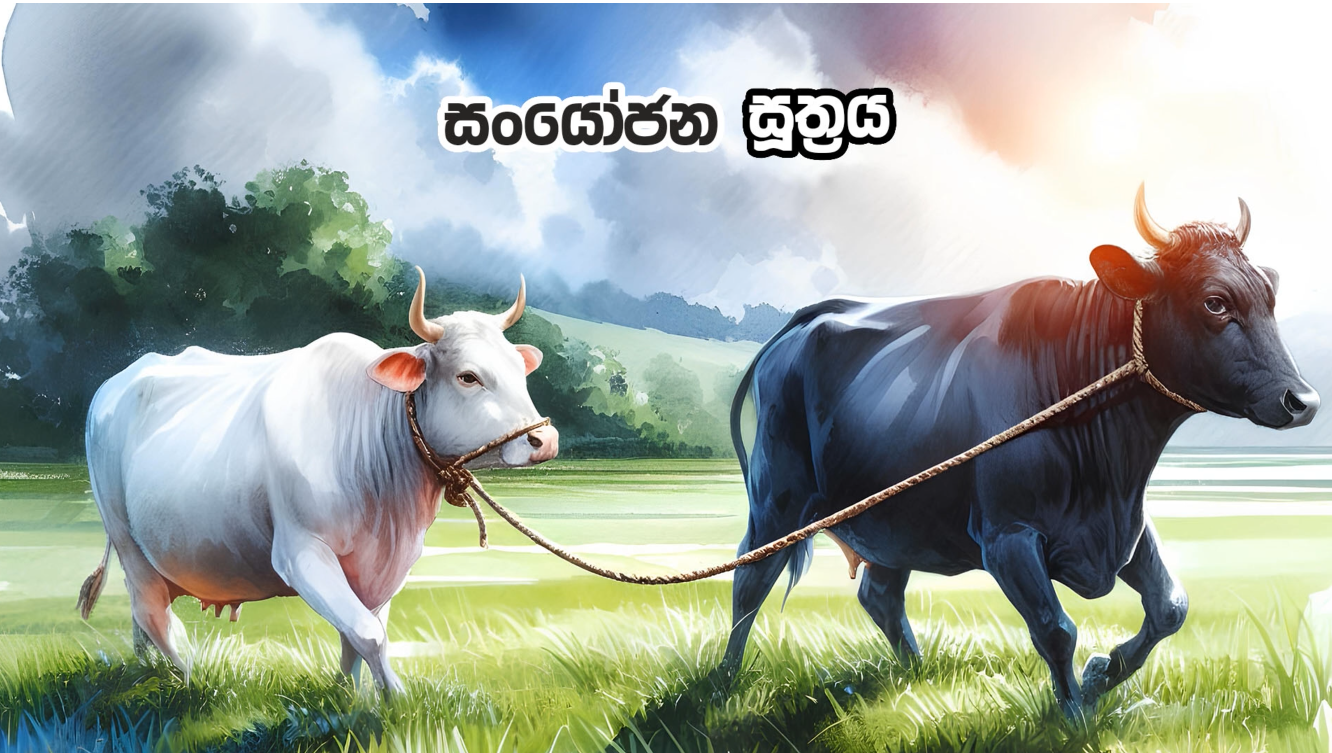
Oxen are tied up together using the Yoke (or a rope). In this analogy the York or rope is the Arya Dukka or the rain.
In other words the delusively conceptualized idea of “I can get it like this, the way I wish I should get it” (මෙසේ වේවා ලැබිය හැකිය). As long as each oxens does not identify the real problem, the yoke (or rope), each one thinks and struggle the problem as something else and become tired and suffer.
චිත්ත වර්ගය 7.1.1. සංයොජන සූත්රය
https://www.thripitakaya.org/tipitakaya/Index/133?s=1838
https://open.tipitaka.lk/sin_apz/sn-4-7-1-1
Concept 8
Without touch or contact (sparsha) there is no sorrow or joy (vedana)

Concept 9
The Same Thing Can Bring Both Sorrow and Joy
(එකමදේ සැපත් වේ, දුකත් වේ.)
The same idea.
The same event.
The same experience.
And yet — it can bring either joy or sorrow.
How is that possible?
The event itself does not carry happiness or sadness inside it. What changes is the way the mind applies its expectation to it — the silent idea:
“I can get it like this… the way I wish… the way it should be.”
That application shifts from moment to moment.
The Job You Lost
Consider losing a job.
At first, anger may arise.
Disappointment may follow.
There may be fear, frustration, or wounded pride.
But imagine something else happens. You later find a better job — better pay, better environment, better growth.
Now what do you say?
“That was actually good for me.”
The same event — being fired — suddenly becomes a blessing.
So which is true?
Was it bad? Or was it good?
It was neither.
It was your interpretation that changed.
The Mind Rearranges the Story
When the job was lost, the mind compared reality against the expectation:
“This should not have happened.”
That gap produced sorrow.
Later, when a better opportunity appeared, the mind rearranged the story:
“This happened for a reason.”
Now it becomes joy.
The event itself never changed.
Only the mental application changed.
A Temporary Relief
If, at the moment of loss, you can think:
“Perhaps this will lead to something better.”
You may reduce anger.
You may soften greed.
You may prevent emotional explosion.
This is helpful. It saves you from immediate vexation. It protects you from those two “water drops” — the sudden emotional reaction.
But understand clearly: this is still a mental strategy.
It is a temporary relief.
The deeper freedom comes not from reinterpreting events positively, but from seeing that events themselves are neutral. It is the mind’s demand — “It should be like this” — that produces both joy and sorrow.
The Deeper Insight
The same rain can nourish crops or ruin a picnic.
The same words can feel like praise or insult.
The same loss can become opportunity.
Joy and sorrow are not stored inside events.
They arise from attachment to expectation.
When you see that clearly, something changes.
You are no longer tossed between happiness and sadness by the same situation.
You begin to observe the movement of the mind instead.
And in that observation, there is space.
And in that space, there is calm.
Concept 10
Must the Mind Always Think, “I Can Get It the Way I Wish”?
Does the idea
“I can get it like this, the way I wish it should be”
always have to arise?
No. Not always.
But unless one has practiced seeing clearly, it will arise almost automatically.
Two Water Drops vs. Rain
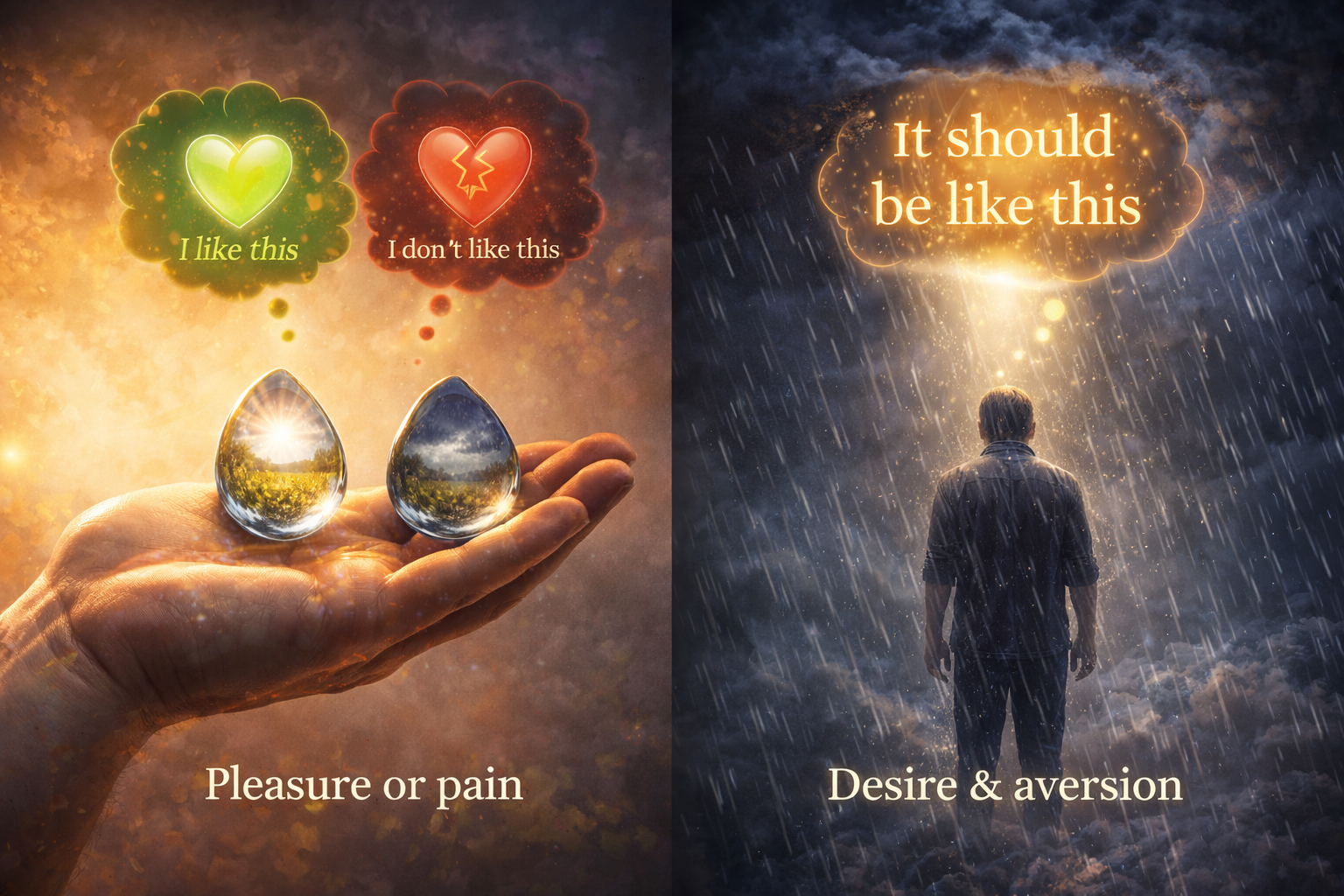
There is a difference between:
- Two water drops — the simple feeling of pleasure or pain (Vipāka Dukkha – the result of conditions), and
- Rain — the mental construction that says, “This should be different. I should get it the way I want.” (Ārya Dukkha – the suffering created by craving).
If you have not practiced separating these two, they merge.
The feeling and the reaction become one.
You feel discomfort — and instantly the thought appears:
“This should not be happening.”
You feel pleasure — and instantly the thought appears:
“This must continue.”
That second layer is the rain.
When Practice Changes Everything
If you practice seeing clearly (Vidarshana — right contemplation), something subtle begins to happen.
You acknowledge:
“This is just feeling.”
“This is just a thought.”
By acknowledging the distinction, the mind does not automatically jump into:
“I can control this. I can arrange this. I can get it the way I wish.”
You still get touched by two water drops — pleasure or pain.
But you are not soaked by rain.
The experience happens.
But the extra suffering does not multiply.
Not Thinking It Is Not Liberation
However, there is another important point.
Some people may not actively think,
“I can get it the way I wish.”
But that does not mean they are free.
It may simply not have occurred to them in that moment.
As long as the possibility of that thought still exists in another situation, the rain can still fall. The tendency remains. The root has not been removed.
True safety is not silence of the thought —
it is the eradication of the tendency for it to arise.
The Subtle Difficulty
Here is what makes this subtle.
- Pleasure or pain — is something felt. (A result, Vipāka.)
- Like or dislike — is something thought. (Constructed.)
- “It should be like this.” — is also something thought. (Constructed delusion.)
All three feel close to each other.
But their weight is worlds apart.
Two drops of water are not the same as standing in heavy rain.
Feeling discomfort is natural.
Thinking “This must not be” is constructed.
Feeling pleasure is natural.
Thinking “This must stay forever or in a certain way that is valuable at that time” is constructed.
The second layer is what creates suffering of a different magnitude.
Seeing Clearly
When the mind believes:
“I can arrange reality to match my preference.”
It enters delusion.
When the mind sees:
“This is just a result. This is just feeling.”
It stays light.
Practice is not about suppressing thought.
It is about recognizing its construction.
When that recognition becomes stable,
rain loses its power.
You may still feel the two drops.
But you are no longer drowned.
Concept 11
In What Ways Do These Actually Give Us Value?
The Hidden Assumption
The assumption is this:
- The value is not in the experience.
- The value is in controlling the experience into a preferred shape.
That is the quiet belief.
And from that belief, suffering begins.
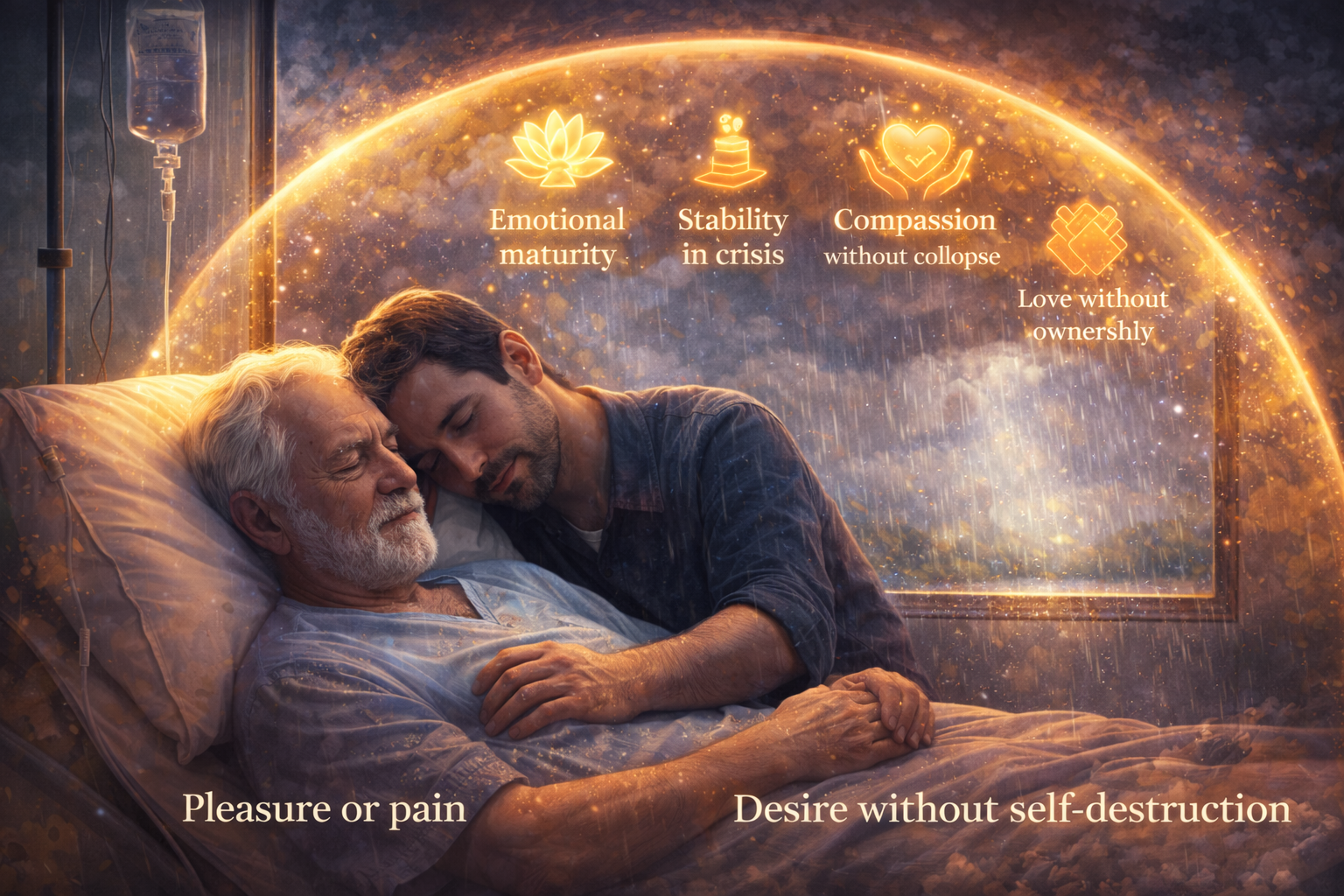
Example 1: A Dying Father
Imagine your father has a terminal illness.
The body is failing.
The doctors have done what they can.
Life is moving in the direction it always moves.
Now observe two layers:
First Layer — Natural Feeling (Two Drops of Water)
- Sadness arises.
- Fear arises.
- Grief arises.
- Tightness in the chest.
- Tears.
This is natural.
This is human.
This is like two drops of water.
Pain, yes.
But clean pain.
Second Layer — Constructed Thought (Heavy Rain)
Now comes the thought:
- “He should not die.”
- “This must not happen.”
- “It has to be different.”
- “I cannot accept this.”
- “It should be the way I want.”
Notice what happened.
The pain of loss has now become:
- Resistance.
- Argument with reality.
- War against what is already happening.
This is not just sadness anymore.
This is rain.
This is what the teachings call dukkha — not mere discomfort, but the suffering created by mental construction.
The father’s illness did not create the rain.
The thought:
“It must be the way I want.”
created the storm.
The Most Difficult Thing to See
The hardest part is seeing:
- The two drops (natural pain)
- The rain (constructed suffering)
as separate.
They feel fused.
They feel like one experience.
But they are not.
One is inevitable.
The other is optional.
The Reverse Question
Now ask honestly:
Is it possible to make the father live exactly the way I want?
If that were possible —
If reality obeyed personal preference —
Then:
- No one would suffer loss.
- No one would age.
- No one would die unwillingly.
- No disappointment would exist.
- No “rain” would exist.
But clearly, that is not how the world operates.
Reality does not reorganize itself around individual desire.
So Where Is the Value?
Now we return to the main question:
In what ways do these thoughts give us value?
When we believe:
“I only get value when it is the way I want.”
We are actually doing something dangerous:
We are tying peace to control.
But control over impermanent conditions is unstable.
So the value we think we are protecting
becomes the very thing we destroy.
The Shift
There is another way to live.
- Feel sadness fully.
- Allow grief.
- Care deeply.
- Love deeply.
But do not add:
“This must not be.”
Then the two drops remain two drops.
They do not turn into rain.
What This Understanding Gives Us
Seeing this clearly gives:
- Emotional maturity.
- Stability in crisis.
- Compassion without collapse.
- Love without ownership.
- Grief without self-destruction.
It does not remove pain.
It removes the second layer.
And that second layer is what multiplies suffering.
Final Reflection
Feeling discomfort is natural.
Thinking:
“This must not be.”
is constructed.
Feeling pleasure is natural.
Thinking:
“This must stay forever, in exactly this way.”
is constructed.
When we see the difference,
we stop fighting the sky.
And when we stop fighting the sky,
even in the rain,
there is peace.

Conclusion
It is impossible to truly achieve:
“I can get it like this, the way I wish, the way I should get it.”
Reality does not bend permanently to preference. Conditions change. People change. Bodies age. Situations unfold beyond personal control.
Just clearly realizing this is already a great achievement.
When we see that we cannot ultimately “get it the way I wish,” then objectives built on that assumption begin to lose their grip. They are not evil — but they are unstable. They promise certainty in a world that does not operate on personal demand.
That wish, that insistence, that inner argument with reality —
is like a rope tying two bulls together.
The bulls pull in opposite directions.
They strain.
They exhaust themselves.
But the real problem is not the bulls.
It is the rope.
And that rope is the idea:
“It must be the way I want.”
We tied it ourselves.
When the rope is seen clearly, it can be loosened.
When it is loosened, the struggle softens.
Not because life obeys us —
but because we stop demanding that it must.
Software Engineer & Data Science| SQL, Analytics, and AI Solutions
Nuwan Hettiarachchi
I bring strong experience in data analytics and data engineering, with a focus on SQL-driven data preparation, data quality, and scalable processing pipelines. My background includes working with large, complex datasets, supporting business intelligence, and applying data governance principles such as profiling, lineage, and documentation. I am known for collaborating effectively across teams to design clear, reliable data solutions that support informed decision-making.

My Story
From Curiosity to Craft: My Journey in Technology and Analytics
My name is Nuwan Hettiarachchi, and my journey has been guided by curiosity, service, and a strong belief in using technology to create meaningful impact.
I began my professional path working closely with data, systems, and people. Early on, I realized that I enjoyed solving practical problems—especially those where analytical thinking and real-world needs intersect. This led me into data analytics, automation, and software development, where I’ve spent years building tools that improve accuracy, efficiency, and decision-making.
A defining part of my journey has been 10 years of volunteer teaching at a charitable organization. Teaching reinforced my belief that knowledge is most powerful when shared. It strengthened my communication skills, patience, and ability to break down complex ideas—skills that continue to shape how I design systems and collaborate with teams today.
Professionally, I’ve worked across data analysis, reporting, and application development. One notable experience was developing a Human Resources appraisal system over two years using Visual Basic and SQL Server, where I translated business rules into reliable, user-friendly software. Projects like this deepened my appreciation for clean data, thoughtful design, and systems that support people—not just processes.
Over time, my work expanded into Python, SQL databases, analytics, and automation, with a growing focus on data integrity and insight-driven solutions. I enjoy building tools that reduce manual effort, surface meaningful patterns, and enable better decisions.
Outside of work, I value balance and mindfulness. I enjoy hiking, traveling, kayaking, and spending time in nature—activities that keep me grounded and curious.
Today, I’m focused on contributing within data science and analytics–driven environments, continuing to learn, mentor, and build solutions that are practical, ethical, and impactful.
Technologies I’ve Worked With


Phone
(604) 256-2432
Surrey BC, Canada