
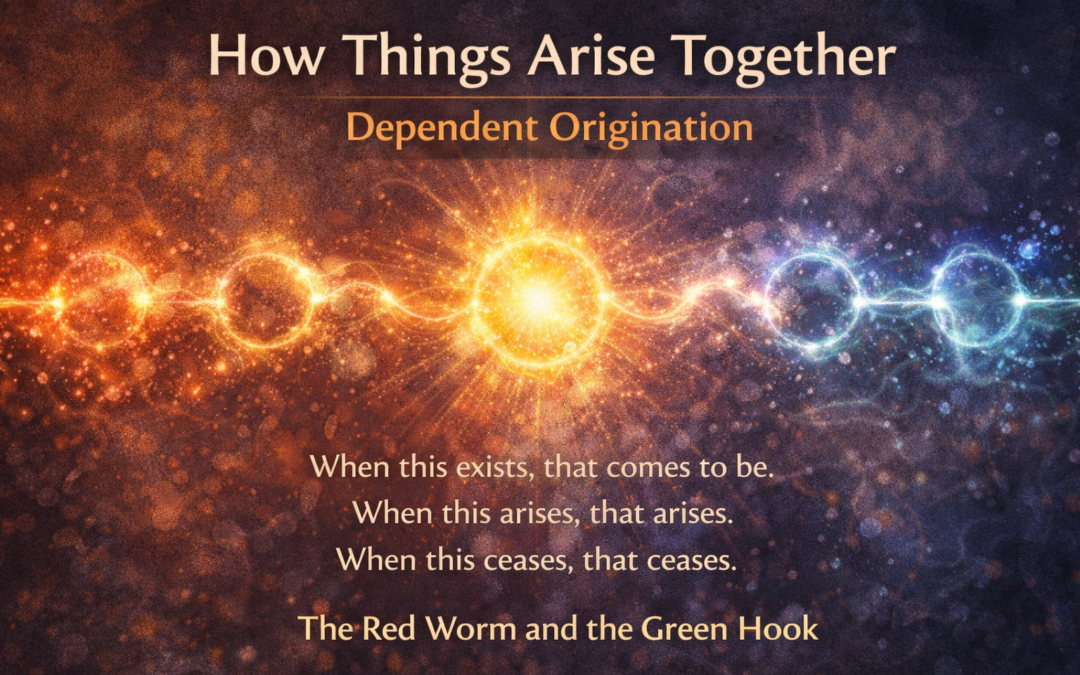
Dependent Origination
පටිච්චසමුප්පාදය
(0:55:00/ 3rd episode)
[1:16:33](https://www.youtube.com/watch?v=VWKvkqsp6yM&t=4593s) ප්රවෘත්ති පටිච්චසමුප්පාදය
[1:20:36](https://www.youtube.com/watch?v=VWKvkqsp6yM&t=4836s) [1:23:06](https://www.youtube.com/watch?v=VWKvkqsp6yM&t=4986s) රතු පණුවා සහ කොල කොක්ක
[1:26:12](https://www.youtube.com/watch?v=VWKvkqsp6yM&t=5172s) විපාකය.
[1:28:48](https://www.youtube.com/watch?v=VWKvkqsp6yM&t=5328s) පෙර පසු නොවී එකවර ඇති වේ
[1:29:30](https://www.youtube.com/watch?v=VWKvkqsp6yM&t=5370s) ලෝභ (තැබිලි) පටිච්චසමුප්පාදය
[1:34:52](https://www.youtube.com/watch?v=VWKvkqsp6yM&t=5692s) තරහ පටිච්චසමුප්පාදය
[1:36:52](https://www.youtube.com/watch?v=VWKvkqsp6yM&t=5812s) මෝහ පටිච්චසමුප්පාදය
[1:38:17](https://www.youtube.com/watch?v=VWKvkqsp6yM&t=5897s) ලෞකික කුසල මූල පටිච්චසමුප්පාදය
[1:40:05](https://www.youtube.com/watch?v=VWKvkqsp6yM&t=6005s) ප්රසාදය ඇතිවෙන්න ඕන. අවිද්යාව සහිතය.
[1:41:14](https://www.youtube.com/watch?v=VWKvkqsp6yM&t=6074s&pp=0gcJCTAAlc8ueATH) ලෝකෝත්තර කුසලමූල පටිච්චසමුප්පාදය.
[1:43:35](https://www.youtube.com/watch?v=VWKvkqsp6yM&t=6215s) Summary
පටිච්චසමුප්පාදය
Dependent Origination (Paṭicca Samuppāda): How Things Arise Together
Dependent Origination is one of the most profound teachings in the Buddha’s Dhamma. But it is not meant to be mysterious or philosophical. It is practical. Immediate. Observable.
It explains one simple principle:
When this exists, that comes to be.
When this arises, that arises.
When this ceases, that ceases.
Nothing stands alone. Everything depends on conditions.
Not a Linear Chain in Time
Often, people think Dependent Origination is a long chain stretching across past lives and future lives. But the crucial insight is this:
It does not always occur as “first this, then later that.”
In experience, many factors arise together — conditioned simultaneously. It is a dynamic process, not a slow mechanical sequence.
When ignorance is present, certain formations arise.
When formations arise, consciousness is conditioned.
And so on.
But in lived experience, these are deeply interwoven. They support each other in one moment.
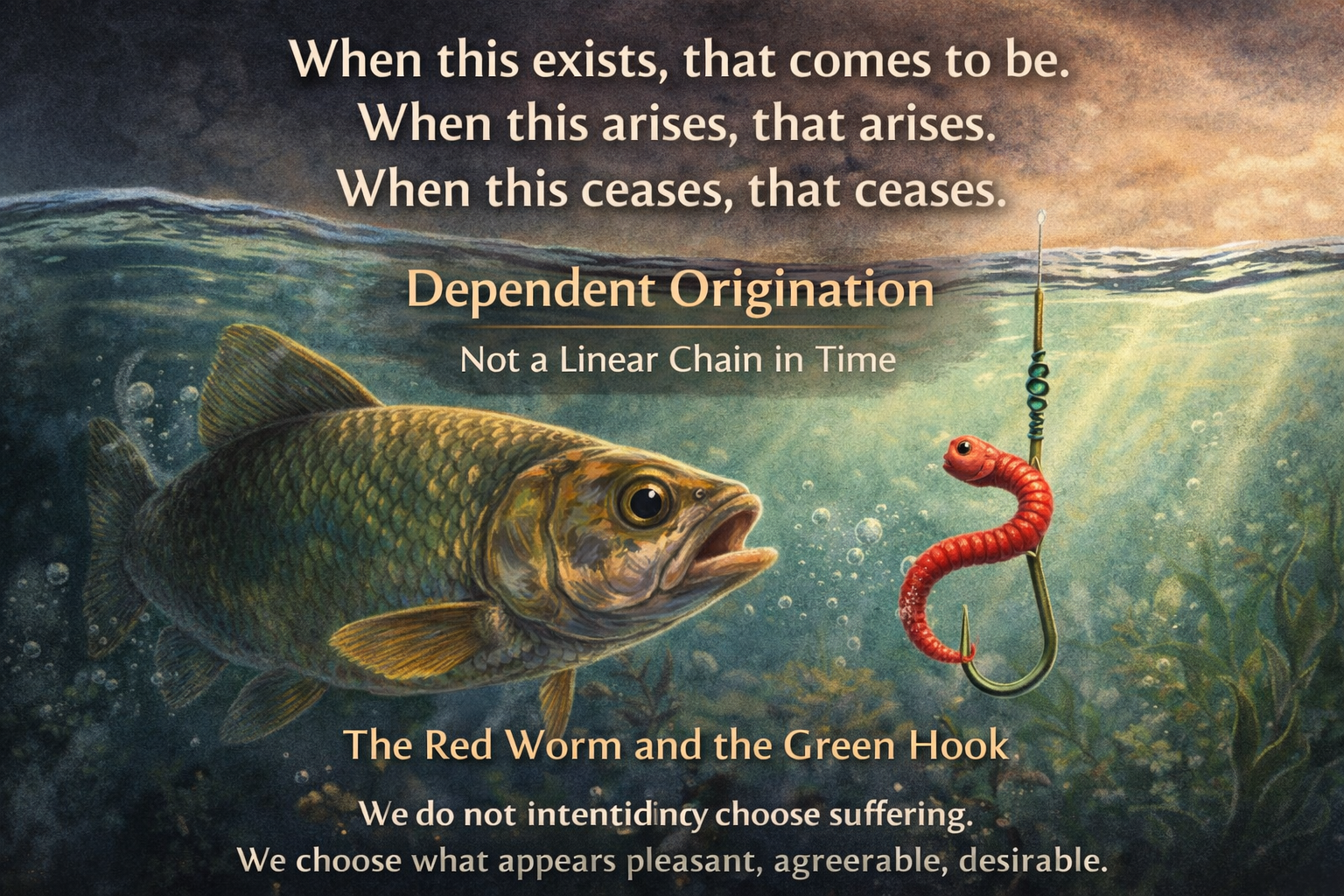
The Red Worm and the Green Hook
A simple example helps.
Imagine a fish sees a red worm. The worm looks attractive. Appealing. Harmless.
But hidden inside is a green hook.
The fish does not bite the hook directly. It bites the worm.
In the same way, we do not intentionally choose suffering. We choose what appears pleasant, agreeable, desirable.
The pleasant sight.
The agreeable thought.
The charming idea.
But embedded within is attachment.
That attachment is the hook.
Dependent Origination explains how the mind moves from simple contact to feeling, from feeling to craving, from craving to clinging, from clinging to becoming — and eventually to suffering.
The hook is already in the process.
Vipāka: Result Is Not Random
Vipāka (result) is not punishment. It is not reward. It is simply the unfolding of conditions.
When certain causes are present, certain results follow.
If craving arises, becoming follows.
If clinging is strong, suffering strengthens.
The result is built into the process itself.
Just as biting the worm already includes the hook, craving already contains its consequence.
Greed-Based Dependent Origination
When greed (lobha) is present, Dependent Origination functions in a specific way.
An object appears.
Pleasant feeling arises.
The mind wants to keep it.
Craving forms.
Clinging strengthens.
A sense of “I” and “mine” develops.
This entire process may unfold within seconds.
The mind says:
“I should have this.”
“I must keep this.”
“This is mine.”
The process feeds itself.
Hatred-Based Dependent Origination
When anger (dosa) arises, the process is similar but inverted.
An unpleasant object appears.
Unpleasant feeling arises.
Aversion forms.
Resistance builds.
Identity strengthens around rejection.
“I don’t want this.”
“This should not be happening.”
“This must go away.”
The hook is still there — only now it is rejection instead of grasping.
Delusion-Based Dependent Origination
With delusion (moha), the process becomes foggy.
There is confusion.
Lack of clarity.
Misunderstanding of impermanence.
Misunderstanding of non-control.
Ignorance conditions distorted perception.
Distorted perception conditions wrong reaction.
And suffering follows quietly.
This is the most subtle form — because we do not even recognize the hook.
Worldly Wholesome Dependent Origination
There is also a wholesome process.
Generosity arises.
Kindness arises.
Moral restraint arises.
But even here, if ignorance is still present, subtle identity may remain:
“I am good.”
“I am generous.”
“I am virtuous.”
There is merit. There is good result. But the root ignorance is not fully removed.
This is worldly wholesome dependent origination.
It improves conditions. It refines the mind.
But it does not yet break the cycle completely.
Supramundane Wholesome Dependent Origination
When wisdom begins to arise — when there is clear seeing of impermanence, unsatisfactoriness, and non-self — the process shifts.
Faith (saddhā) arises.
Investigation arises.
Energy arises.
Mindfulness strengthens.
Concentration stabilizes.
Wisdom penetrates.
Here, ignorance weakens.
Craving is not fueled.
Clinging loosens.
This is supramundane wholesome dependent origination — the process that leads toward liberation.
It is still conditional.
But its direction is different.
Instead of building becoming, it dismantles it.
The Essential Insight
Dependent Origination is not just a doctrine to memorize.
It is something to observe:
- How does liking become craving?
- How does craving become identity?
- How does identity become suffering?
When we see the process clearly, we no longer blame the world.
We see the conditions.
And when ignorance is removed, the entire structure collapses.
The worm loses its power.
The hook cannot catch.
And suffering, which once seemed unavoidable, is understood as conditioned — and therefore, stoppable.
It is not fatalistic.
It is not abstract philosophy.It is a map of how suffering begins —
and how it can end.
Software Engineer & Data Science| SQL, Analytics, and AI Solutions
Nuwan Hettiarachchi
I bring strong experience in data analytics and data engineering, with a focus on SQL-driven data preparation, data quality, and scalable processing pipelines. My background includes working with large, complex datasets, supporting business intelligence, and applying data governance principles such as profiling, lineage, and documentation. I am known for collaborating effectively across teams to design clear, reliable data solutions that support informed decision-making.

My Story
From Curiosity to Craft: My Journey in Technology and Analytics
My name is Nuwan Hettiarachchi, and my journey has been guided by curiosity, service, and a strong belief in using technology to create meaningful impact.
I began my professional path working closely with data, systems, and people. Early on, I realized that I enjoyed solving practical problems—especially those where analytical thinking and real-world needs intersect. This led me into data analytics, automation, and software development, where I’ve spent years building tools that improve accuracy, efficiency, and decision-making.
A defining part of my journey has been 10 years of volunteer teaching at a charitable organization. Teaching reinforced my belief that knowledge is most powerful when shared. It strengthened my communication skills, patience, and ability to break down complex ideas—skills that continue to shape how I design systems and collaborate with teams today.
Professionally, I’ve worked across data analysis, reporting, and application development. One notable experience was developing a Human Resources appraisal system over two years using Visual Basic and SQL Server, where I translated business rules into reliable, user-friendly software. Projects like this deepened my appreciation for clean data, thoughtful design, and systems that support people—not just processes.
Over time, my work expanded into Python, SQL databases, analytics, and automation, with a growing focus on data integrity and insight-driven solutions. I enjoy building tools that reduce manual effort, surface meaningful patterns, and enable better decisions.
Outside of work, I value balance and mindfulness. I enjoy hiking, traveling, kayaking, and spending time in nature—activities that keep me grounded and curious.
Today, I’m focused on contributing within data science and analytics–driven environments, continuing to learn, mentor, and build solutions that are practical, ethical, and impactful.
Technologies I’ve Worked With


Phone
(604) 256-2432
Surrey BC, Canada