

The Hedonistic View of Money and Pleasure
(Kāmasukallikānuyoga in Buddhism and Eastern Thought)
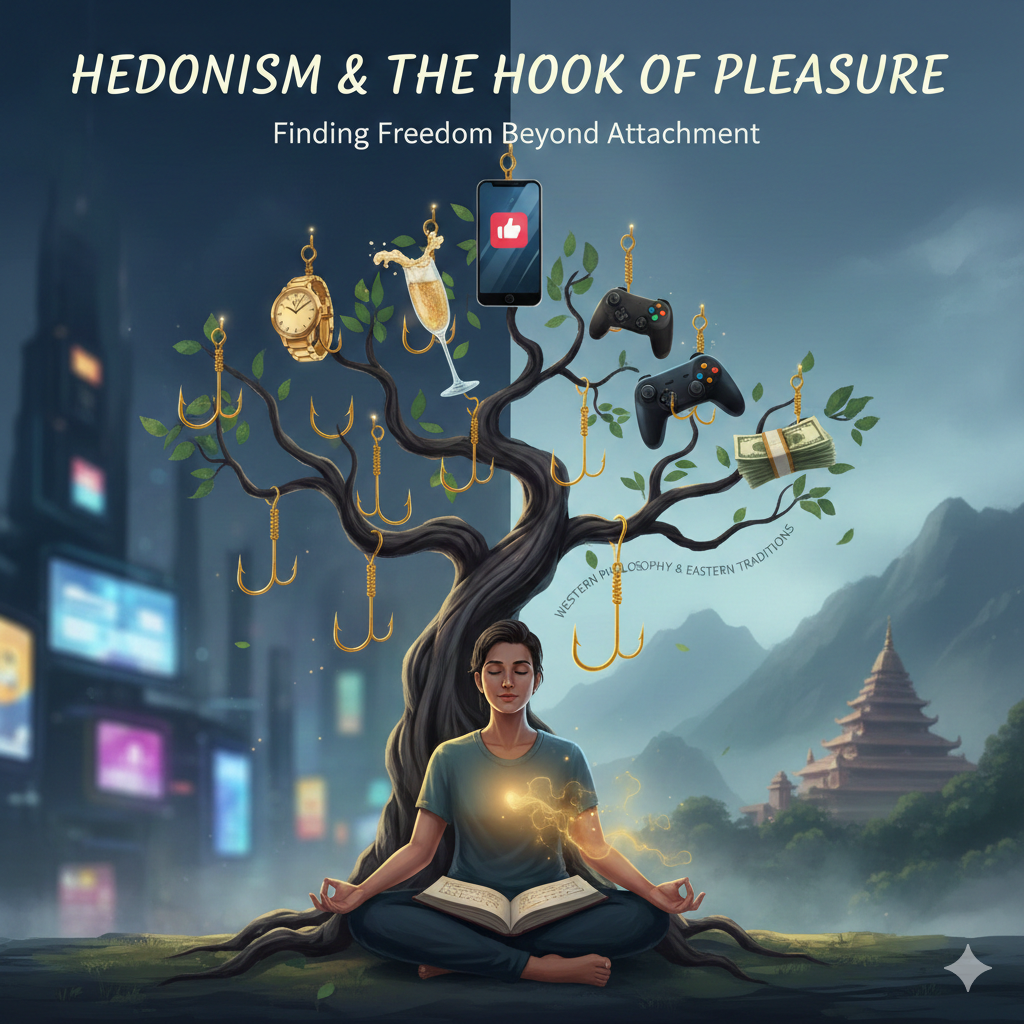
Some time ago, I wrote about the Utilitarian view of life and value. Today, I want to explore a different orientation—the Hedonistic view of money and pleasure, known in Buddhism and many Eastern philosophies as Kāmasukallikānuyoga, the devotion to sense pleasure.
This view does not merely shape how we consume money; it shapes how we define a successful life.
The Death of the Existentialist (Jean-Paul Sartre)
Jean-Paul Sartre raised a famous existential question:
Who determines the value of your life?
Is it you—or those who gather around you?
At first glance, the answer seems simple: you decide your own value.
But the question becomes more complex when turned around.
What if value is measured by how others remember you?
Your legacy, reputation, and impact often live not in your own mind, but in the minds of others.
So which view is correct?
- The value you assign to yourself?
- Or the value others assign to you?
And ultimately—who decides what a life is worth?
The Existentialist Position
Think about a knife.
Normally, we design a knife based on what we want to cut. Purpose comes first; the object follows.
Existentialists reverse this logic.
They argue that life exists first, without inherent purpose. Meaning is created afterward. Life is a blank page, a blank map.
To navigate this map, many existentialists implicitly use hedonism as their compass.
They choose direction based on maximum pleasure:
- enjoyment with family and friends,
- entertainment,
- success,
- comfort,
- experiences that feel good.
In this view, pleasure becomes the guide, and life is drawn in the direction of satisfaction. The map of one’s life is shaped by where pleasure seems greatest.
Levels of Pleasure
Pleasure is not a single thing. It exists in layers.
- Sensory Pleasure (Indriya Santarpanaya)
Pleasure derived from satisfying the senses—sight, sound, taste, touch, and smell. - Comfort (Sanaseema)
Ease and relaxation—like sipping coffee while rain falls on your patio. - Satisfaction / Fulfillment
Completing a goal—passing an exam, achieving a long-sought milestone. - Blissful Pleasure
A deeper joy born from understanding—radiating happiness beyond the self. - Ecstasy (Dhyanic Absorptions)
Refined mental pleasure, lighter than worldly experience, accessed through deep concentration. - Liberation
The highest level—beyond pleasure, beyond pain, beyond existence itself.
Jeremy Bentham and Quantified Pleasure
Jeremy Bentham famously said:
“The quantity of pleasure being equal, push-pin is as good as poetry.”
If pleasure can be measured purely by quantity, then all pleasures are equal.
Following this logic, one second of dhyānic pleasure should be no different from any other pleasure of equal duration.
However, Eastern traditions—especially Buddhism—disagree. They teach that one second of dhyānic pleasure surpasses countless moments of sensory pleasure.
This raises a difficult question.
A Thought Experiment
Which would you choose?
- Option 1:
One second of dhyānic pleasure, followed by 100 years of a plain, simple life. - Option 2:
100 years of maximum hedonistic pleasure, followed by one second of dhyānic pleasure.
Many people would instinctively choose Option 2.
Why?
Because the mind is trained to value quantity, stimulation, and continuity of pleasure—not depth.
Charvaka’s Question
The ancient Charvaka school posed a blunt challenge:
“If there is no ātma, no samsaric existence, then what is there beyond pleasure and pain?”
If there is nothing after death, no rebirth, no liberation—then pleasure becomes the only meaningful currency of life.
This is the logical foundation of radical hedonism.
Epicurus: Rational Hedonism
Epicurus is often misunderstood.
He did not advocate endless indulgence. His hedonism was rational—seeking pleasure through simplicity, restraint, and freedom from fear.
For Epicurus, the highest pleasure was not excess, but tranquility.
Utilitarian Ethics
Utilitarianism builds on a similar premise:
Human beings are governed by pleasure and pain.
If ethical action is that which maximizes pleasure and minimizes suffering, then morality becomes a calculation.
The “best” action is the one that produces the greatest total pleasure.
But this raises an uncomfortable question:
Is all pleasure equal?
Problems in Hedonism
- Benchmarking Pleasure
Once a level of pleasure becomes normal, it loses its appeal. The mind constantly seeks the next level, leading to restlessness and dissatisfaction. - Addiction to Sensory Pleasure
Overindulgence dulls sensitivity to deeper pleasures. Life becomes flat, even when filled with stimulation. - Dissonance Between Pleasure and Satisfaction
Pleasure does not always bring fulfillment. One can have endless pleasure and still feel empty.
The Buddhist Perspective
Buddhism does not reject pleasure.
None of the six levels of pleasure are condemned in themselves.
What Buddhism warns against is attachment.
From the Bālisika Sutta (SN 35):
“There are ideas cognizable via the intellect—agreeable, pleasing, charming, endearing, fostering desire, enticing.
If a monk does not relish them, welcome them, or remain fastened to them,
he has not swallowed Māra’s hook, who has snapped the hook, who has broken the hook, who has not fallen into misfortune & disaster.
The Evil One cannot do with him as he will.”
Pleasure is not the problem.
Clinging is.
When pleasure is experienced without relishing, welcoming, or fastening to it, it does not bind. It does not enslave. It does not lead to suffering.
Closing Reflection
Hedonism answers the question “How do I live?”
Buddhism asks “How do I relate to experience?”
The danger is not pleasure itself—but mistaking it for freedom.
Software Engineer & Data Science| SQL, Analytics, and AI Solutions
Nuwan Hettiarachchi
I bring strong experience in data analytics and data engineering, with a focus on SQL-driven data preparation, data quality, and scalable processing pipelines. My background includes working with large, complex datasets, supporting business intelligence, and applying data governance principles such as profiling, lineage, and documentation. I am known for collaborating effectively across teams to design clear, reliable data solutions that support informed decision-making.

My Story
From Curiosity to Craft: My Journey in Technology and Analytics
My name is Nuwan Hettiarachchi, and my journey has been guided by curiosity, service, and a strong belief in using technology to create meaningful impact.
I began my professional path working closely with data, systems, and people. Early on, I realized that I enjoyed solving practical problems—especially those where analytical thinking and real-world needs intersect. This led me into data analytics, automation, and software development, where I’ve spent years building tools that improve accuracy, efficiency, and decision-making.
A defining part of my journey has been 10 years of volunteer teaching at a charitable organization. Teaching reinforced my belief that knowledge is most powerful when shared. It strengthened my communication skills, patience, and ability to break down complex ideas—skills that continue to shape how I design systems and collaborate with teams today.
Professionally, I’ve worked across data analysis, reporting, and application development. One notable experience was developing a Human Resources appraisal system over two years using Visual Basic and SQL Server, where I translated business rules into reliable, user-friendly software. Projects like this deepened my appreciation for clean data, thoughtful design, and systems that support people—not just processes.
Over time, my work expanded into Python, SQL databases, analytics, and automation, with a growing focus on data integrity and insight-driven solutions. I enjoy building tools that reduce manual effort, surface meaningful patterns, and enable better decisions.
Outside of work, I value balance and mindfulness. I enjoy hiking, traveling, kayaking, and spending time in nature—activities that keep me grounded and curious.
Today, I’m focused on contributing within data science and analytics–driven environments, continuing to learn, mentor, and build solutions that are practical, ethical, and impactful.
Technologies I’ve Worked With


Phone
(604) 256-2432
Surrey BC, Canada